A Design for Life: Meet the organiser and host of the Astbury Conversation public engagement event

Find out more about an exciting free public engagement session taking place here at Leeds on 21 April, as part of the Astbury Conversation.
A Design for Life is an opportunity for anyone aged 16 plus to come along and find out more about the latest developments and advancements around the emerging field of Designing Biology.
Event organiser Katie Simmons and host Trent McLean-Ash discuss how they got into research, some of the most existing developments in their field and what they’re most looking forward to about the public event.
Can you tell us a little about your current roles?
Katie: I've been at Leeds for nearly 21 years, having arrived as a PhD student in 2005. I'm now a Lecturer in Structural Pharmacology in the School of Biomedical Sciences. My research involves identifying early-stage small molecules for drug discovery, looking at new targets, finding molecules to modulate those targets, and carrying out early-stage optimisation. I also teach on a number of pharmacology and drug discovery courses.
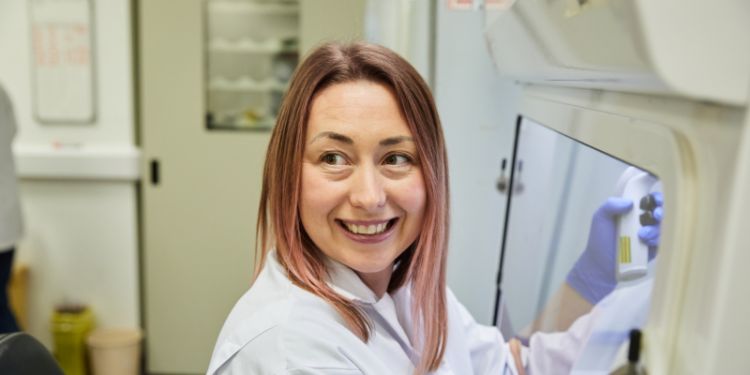
Image: Event organiser Katie Simmons in the lab
Trent: I joined the University in 2017 to study medical biochemistry, and enjoyed it so much that I stayed on for a Masters by research, and I'm now in the fourth and final year of my PhD. My research investigates post-transcriptional and translational control in prokaryotes, specifically in streptomyces, a pretty cool bacteria that is responsible for roughly 60% of the natural products we use, including many antibiotics. I'm essentially looking into how they make their proteins.
How did you get into science - was there a particular moment or experience that sparked your interest?
Katie: I can't remember ever not wanting to be a scientist. No one in my family has anything to do with science, but I always loved it at school. My mum's still got a picture I drew in Year Seven of what I saw myself doing as a career, and I was in a science lab. Everyone else drew footballers and things.
I was fortunate to attend some events at Leeds as a school student. In those days they still did live chemical demonstrations in the lecture theatres. That, alongside a lab day, really sparked my interest and led me to pursue Chemistry as a degree.
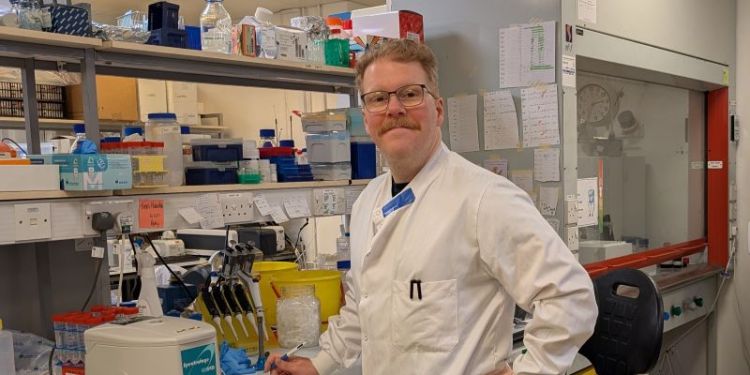
Image: Trent McLean Ash, host of this year’s public engagement event
Trent: My path was quite different. When I did my GCSEs, I barely scraped through my science exams and went straight into retail. In my early twenties, while training as a baker, I did a qualification at University College Birmingham. During that course we looked at the science behind baking, for example why you add sugar to a yeast mixture. I was told the yeast eats the sugar and the bread rises, but I wanted to know how that happened. When I looked it up and discovered it produced carbon dioxide and ethanol, that sparked an interest in science that sat in the back of my mind for four or five years.
I eventually did an access course at the University of Derby and came to Leeds in my late twenties to do my degree. It was a later start than most, but it worked for me.
Why does biological research matter beyond the laboratory?
Katie: For me it’s about the way I'd like my research to make a difference. Working with patient groups on the different projects I'm involved in, even at very early stages, reinforces why it matters. Academic research can really help to explore areas that may be neglected by the large pharmaceutical companies. Beyond that, I'm passionate about the training element – making sure that people develop the right skills to go out into their world or work and succeed, whatever direction they choose to go in.
Trent:
There are so many things we don't understand in the world, and understanding them allows you to view the world more broadly. Many of those things cause pain and discomfort to people. Even making a tangential contribution towards discovering what those things are and how we might alleviate them is a worthwhile endeavour.
I don't think many people come into science thinking they're definitely going to cure a specific disease, but if enough people discover things that contribute, or even simply establish what doesn't work so that others don't have to repeat it, that eventually leads to what might be miraculous breakthroughs.
What are the most exciting developments in your areas of research?
Katie: The incorporation of artificial intelligence into drug discovery has been on the periphery for almost a decade, but for a long time it was more of a buzzword than a genuinely useful tool. I think that's changed, and it won't be long before a molecule with its origins in AI reaches the clinic.
The aspect I find most exciting is protein design; the way the AI system AlphaFold has enabled us to see structures of proteins we've never had access to before has been a remarkable development, and embedding that into the drug discovery pipeline alongside other AI tools is going to revolutionise the field.
Trent: Working predominantly with ribonucleic acid (RNA), I'd highlight the 2023 and 2024 Nobel Prizes for RNA-related discoveries. The nucleoside-based modifications underpinning many COVID vaccines have proven that mRNA-based approaches work, and the discoveries that follow will build on that foundation. Historically, RNA was seen as simply the intermediary between DNA and proteins, but we're increasingly discovering that it plays a very important role in regulation in its own right.
What advice would you give to someone considering a career in science?
Katie: Be prepared for things not to go as expected, and for it not all to be plain sailing. When students are doing their A-levels, and even during their degrees, experiments are carefully designed to work. When they move into research or industry, that's no longer the case. Resilience is really important.
Trent: If you discover an interest in science at any stage, go for it. Science is really broad and you don't need to worry about pigeonholing yourself early on. I'd also be honest and say that it shouldn't be viewed as an easy route to financial reward. I could have worked my way up in retail, but instead, I'm a PhD student. But I'm doing it because the interest is there, and that's the right reason to pursue it.
What drew you to the Astbury Conversation, and what are you both looking forward to?
Katie: The thing I've been enjoying most about organising the event is the chance to work with people I wouldn't normally work with, and to talk about things beyond my immediate research. I'm really keen to push science out to the public and to showcase everything the University does.
I'm also looking forward to trying the new format. In previous years, the public-facing event has involved a single speaker delivering a lecture, but this year we are going for a more interactive approach, so really involving the audience and helping them understand what this research means for them.
Trent: My background in retail means the language I speak now is completely different from the language I spoke ten years ago. I like to involve myself in events that make this new language more accessible, because I know from experience how hard it can be to engage with science without a scientific background. The Astbury Conversation is a real opportunity to change that.
We have three speakers with a strong track record in public science communication, and I'm looking forward to seeing the excitement they will spark. And to receiving some challenging questions from the audience!
Further information
‘A Design for Life’, the public engagement session for the Astbury Conversation, will take place at the Esther Simpson building, the University of Leeds on Tuesday 21 April, 12-3pm. It is free to attend and open to anyone aged 16 plus.